
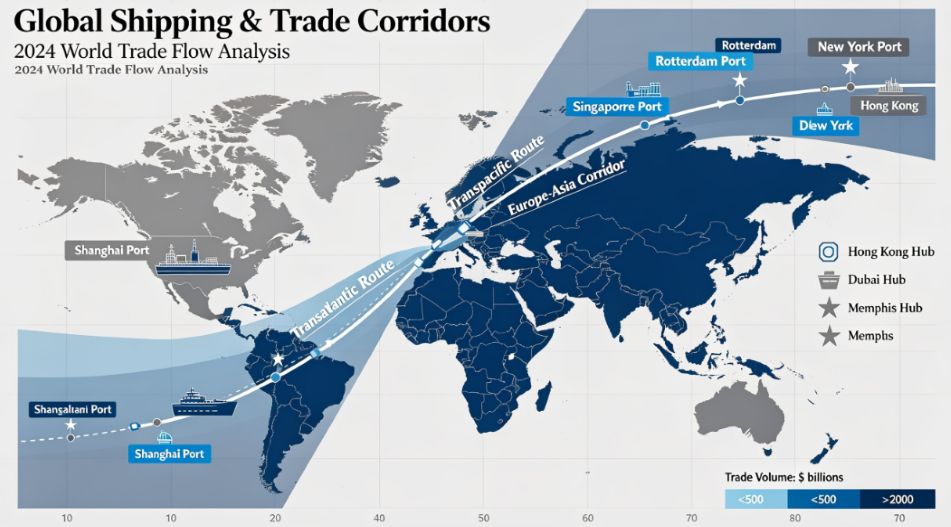
Global merchandise trade continued to recover through 2025 and into 2026, although growth remained uneven across regions. Data from the World Trade Organization (WTO) and the International Monetary Fund (IMF) shows that resilient consumer demand, easing inflation, and improving shipping conditions supported trade volumes, while geopolitical tensions and industrial policies continued to reshape cross-border commerce.
As nations realign partnerships and reroute logistics, we examine the trade-offs between resilience, efficiency, and growth. Recent developments suggest that businesses are balancing two competing priorities. One emphasizes reducing strategic dependence on individual suppliers, while the other recognizes that global production networks still deliver significant cost advantages. Research shows that these opposing forces are influencing investment decisions, manufacturing locations, and long-term sourcing strategies.
Current State: Trade Volumes, Policy Shifts, and Geopolitical Pressures
Reports from the WTO indicate that international trade has remained more resilient than many analysts expected following disruptions earlier in the decade. At the same time, governments have expanded industrial support through measures such as the United States’ manufacturing incentives, the European Union’s strategic industry programs, and Asia’s continued investment in advanced production.
Geopolitical competition continues to influence customs policies, export controls, and technology restrictions. Experts at the Organisation for Economic Co-operation and Development (OECD) note that while these measures aim to strengthen national security, they can also increase compliance costs and create uncertainty for multinational companies.
Drivers Pulling Supply Chains Apart
Several trends continue to encourage fragmentation. Near-shoring has accelerated as manufacturers move production closer to consumer markets to reduce transportation risks. Friend-shoring has gained momentum as companies prioritize suppliers located in politically aligned countries. Diversification strategies have also expanded, with businesses spreading production across multiple regions instead of relying on a single manufacturing hub.
Findings from the World Bank suggest that these approaches improve resilience against disruptions, although they often require higher capital investment and duplicate production capacity.
Forces Supporting Greater Coordination
Despite growing fragmentation, economic integration remains attractive. Large-scale manufacturing ecosystems, efficient ports, and established logistics networks continue to lower production costs. Studies published by the United Nations Conference on Trade and Development (UNCTAD) highlight that many developing economies still depend heavily on open trade to support employment, exports, and economic growth.
Regional trade agreements and digital customs modernization are also helping reduce friction between participating economies. These initiatives demonstrate that cooperation remains valuable even as strategic competition intensifies.
Key Sectors Facing the Greatest Impact
Energy markets continue adapting to shifting export routes and investment patterns. Semiconductor production remains concentrated in a limited number of economies despite substantial expansion efforts in North America, Europe, and parts of Asia. Agriculture is experiencing changing trade flows as climate events, food security concerns, and transportation costs influence sourcing decisions.
- Energy companies are investing in more diversified export infrastructure.
- Chip manufacturers are expanding fabrication capacity across multiple regions.
- Agricultural exporters are developing alternative shipping corridors and storage networks.
Two Possible Paths Toward 2027
One scenario sees continued fragmentation, with additional trade barriers, regional manufacturing clusters, and higher production costs. This path could improve supply security while slowing productivity growth and increasing prices for businesses and consumers.
The alternative scenario involves selective integration. Governments maintain security-focused safeguards while expanding cooperation on logistics, digital trade, and critical infrastructure. The IMF has suggested that limiting excessive fragmentation could support stronger global output and reduce long-term economic losses compared with widespread trade separation.
Preparation will remain essential regardless of which path emerges. Businesses that diversify suppliers, strengthen inventory planning, invest in digital supply chain visibility, and monitor geopolitical developments will likely be better positioned to manage future disruptions while remaining competitive in an increasingly complex global trading environment.